
WhatsApp Business API: 2025 Guide
June 2026
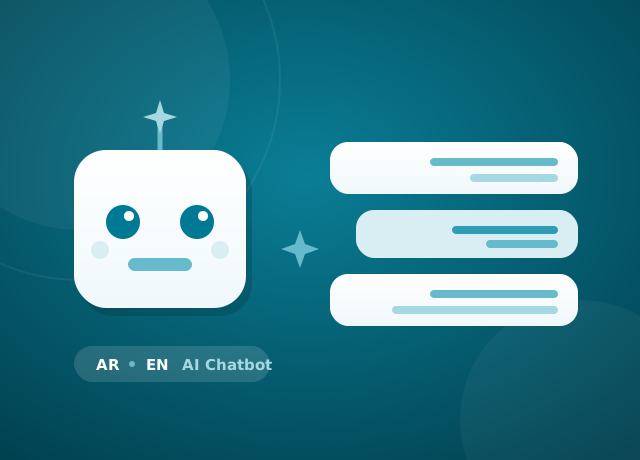
In the GCC, more than 70% of customers prefer to be served in Arabic, yet most chatbots still reply in stiff English or robotic Modern Standard Arabic. The result is abandoned chats, frustrated shoppers and lost revenue. A well-built Arabic AI chatbot does the opposite: it understands how Gulf customers actually write, answers in their tone, and quietly moves the conversation toward a sale. Here is how to build one that earns trust.
An English-only bot tells a large share of your audience that they are an afterthought. In markets like Saudi Arabia and the UAE, customers who hit an English wall often abandon the chat within seconds and message a competitor instead. Beyond preference, it is a comprehension issue: nuance, complaints and high-value purchase questions get lost in a second language. Brands that switch on Arabic support typically see noticeably higher response rates and far fewer dropped conversations on WhatsApp and Instagram.
Modern Standard Arabic (MSA) is correct, formal and understood everywhere, which makes it safe for banking, government and legal contexts. But everyday Gulf customers chat in dialect, and a bot that replies in pure MSA can feel cold or bureaucratic. The smart approach is a blended voice: comprehend Khaleeji dialect on the way in, then respond in warm, simplified MSA with a few familiar Gulf touches. Match the register to the sector, more formal for finance, more conversational for retail and food delivery.
A generic Arabic model knows the language; it does not know your prices, return policy or branch hours. Train it on your real assets: product catalog, FAQs, past WhatsApp transcripts, and your store policies. Aim for at least 50 to 100 real question variations per key topic so the bot recognizes how customers truly ask, not the textbook version. With Stepup, you upload these sources into one knowledge base, and the AI grounds every answer in your own content rather than guessing.
Real Gulf chats are messy: a single message might mix Arabic, English and Arabizi, the habit of writing Arabic in Latin letters and numbers, like 'el 7esab' or '3andkom delivery?'. A bot that cannot parse this looks broken. Your Arabic AI must normalize Arabizi (3 to ع, 7 to ح, 2 to ء) and detect intent across mixed-script sentences. Then it should answer in the customer's lead language, keeping brand and product names in their original form so nothing gets lost in translation.
Keep replies short and right-aligned for proper RTL display, and use the 24-hour clock and local currency (AED, SAR, KWD). Always offer a clear handoff to a human agent for sensitive or high-value cases, ideally within one tap. Respect prayer times and weekend patterns in your auto-responses, and never let the bot pretend to be human. Test with real Saudi, Emirati and Kuwaiti phrasing before launch, then review weekly transcripts to catch missed intents and refine answers.
A great Arabic chatbot is only as useful as the channels it lives on. Stepup unifies WhatsApp, Instagram, Messenger, Telegram, TikTok and Web Chat into a single AI inbox, so the same Arabic-trained assistant works everywhere your GCC customers already are, with broadcasts, analytics and built-in CRM. You see every conversation, hand off to your team seamlessly, and measure exactly how many chats turn into sales. Ready to see your Arabic AI chatbot in action? Book a Stepup demo and we will set up a tailored Gulf-ready bot for your business.
June 2026
June 2026
June 2026